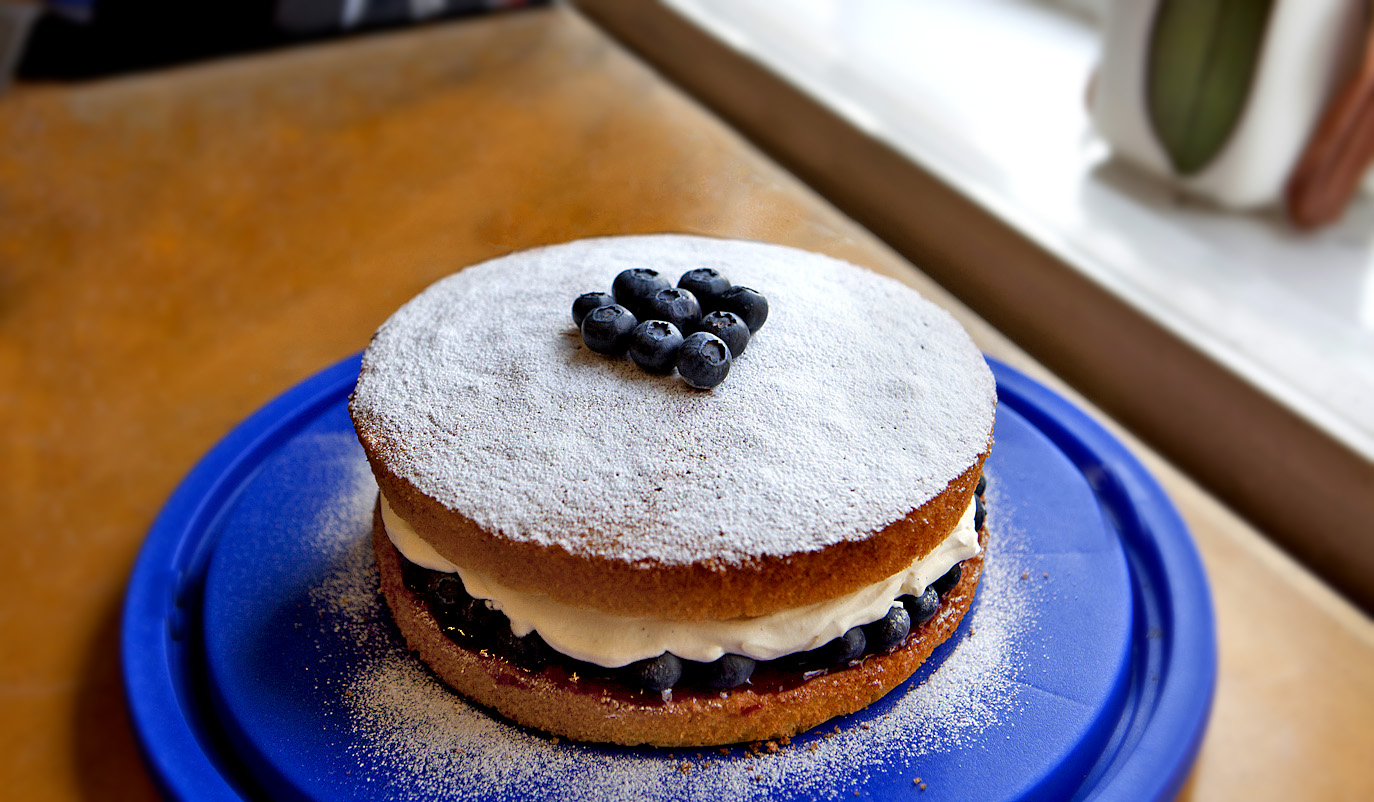
Blueberry Victoria Sponge Cake


I am still on a mission to convince people that eating cake for breakfast is perfectly normal.

Especially in England, this is not the done thing  – not even on a birthday or another special occasion it seems. I remember being at a friend’s house for a leisurely Easter breakfast a few years ago and asking for a slice of the cake left over from the previous day’s afternoon tea and being told “But not for breakfast!” – and a look of shock and disgust stayed on my hosts faces for the next few minutes.

Well, I decided the best way to missionarize was by bringing cakes to work when it is someone’s birthday and present them their birthday cake as soon as they come in to the office in the hope we will cut into it before lunch, for a little brunch time treat.

Most recently it was Celia’s birthday and Celia is known for liking blueberries so it had to be a birthday cake with the little blue superfruits. With blueberries I would usually make muffins rather than cakes but I thought they might work nicely in a classic Victoria Sponge. It’s not a typical combination like the traditional strawberry Victoria sandwich cake but it went down a treat.

Despite the birthday girl trying to convince us the birthday cake should not be eaten before 4 o’clock, I am glad to say everyone else was having none of it and after we convinced her, everyone had a piece before noon…

For a Victoria Sponge with Blueberries you will need:

  • 2 round 18cm/7” cake tins
  • 175g butter
  • 175g caster sugar
  • 3 eggs
  • 175g self-raising flour 
  • 1 1/2 level tsp baking powder
  • ca 4 Tbsp of damson jam (blackberry, black current might work equally well)
  • 1 punnet of blueberries
  • 1 small pot of whipping cream
  • a sprinkle of icing sugar

Preheat oven to 180 degrees/ gas mark 4 and grease and line the base of the two sandwich tins.

Mix the flour with the baking powder and set aside.

In a bigger bowl cream the butter and sugar with a handheld whisk, then add one egg followed by a generous table spoon of the flour and whisk again, before repeating this with the other eggs and more flour, adding all the flour after the third egg.

Divide the batter evenly between the tins and level flat with the help of a spatula.

Bake for 25mins until the cakes are springy to the touch and a tooth pick inserted in the cake comes out clean (take them out as soon as this is the cake – don’t be tempted to brown them longer which would result in dry cakes!). Leave to cool in the tins for about 5 minutes then turn the cakes out, peel the parchment off and finish cooling on a wire rack.

In the meantime whisk up the whipping cream until it holds shape.

When the cakes are completely cool spread the top of one with jam and cover it with berries (the jam makes the cake more fruity and also stops the berries from rolling off), then spread the cream and sandwich the cakes together.

Dust with icing sugar before serving.
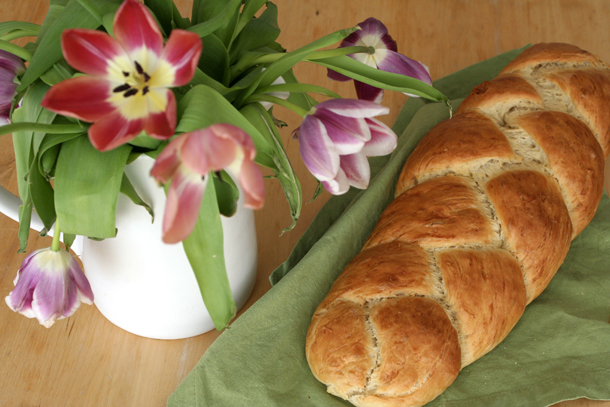
Easter Bread “Hefezopf”

Happy Easter!

I am in Berlin for the Easter weekend and will therefore only do a very short post, as I am on a mini laptop that’s not the easiest to type on…

And as it’s almost Easter Sunday I have to quickly get upload this post, on time for the occasion.

I wanted to give a recipe for something “easter’y” and a typical Easter brunch in Germany includes a traditional “Hefezopf”, which literally translated means “yeast-plait” (not a very appetizing name in English, I know). It’s a lightly sweet yeast based bread, also called a “chola” in English. It tastes a bit like a heavier brioche and can be made with nuts and marzipan as a fancier version. Some people also add hard boiled coloured eggs, that get bedded into the plait before baking. I stuck to the most basic version of them all, as given to me by my mom. 

You need:

  • 500g flour
  • 1 tsp salt
  • 20g fresh yeast
  • 1 tsp sugar
  • 70g butter
  • 250ml milk
  • 1 egg 

Start by warming up the milk (keeping a little aside for later) and mixing the fresh yeast in to the warmed milk. Mix the flour with the salt and sugar in a big bowl and pour the fluid in and knead together with the help of the kneading paddles of the electric whisk.

Then cover the bowl with cling film and set aside in a warm place, such as near a heater or under a blanket and allow to rise for 1 hour.

When the dough has doubled in size add the butter, by melting it and then kneading it into the dough. Again, set aside in a warm spot and leave to rise again, for about 40 mins.

Take out the risen dough and knead it again, this time by hand and on a floured surface. Divide it in to three pieces with which you form three rolls of the same length. Place the rolls parallel to each other and plait, as you would plait hair. 

Again, set the plaited dough aside for another 30 mins to allow it to rise some more, during which time you should preheat your oven on to 200 degrees. 

Mix the egg with the left over milk and brush the plait with this mix before baking it for 35-40 minutes.

The bread is best eaten on the day of baking – topped with butter and jam!

Peanut Butter Cookies

I am rather busy at the moment having started a new job and sorting out all sorts of things that have been put on hold while I was in Africa.

I therefore didn’t have a whole long morning to have a leisurely brunch this weekend. Instead I had to have a brunch treat that I could take with me on a run of errands. A muffin would have been the obvious choice but I fancied something a little naughtier and also quick to make, so I thought of cookies.

There are quite a few recipes for breakfast cookies; usually oat based ones, made from similar ingredients found in morning muesli. I will probably feature such cookies in the future but this time I went for a typical American peanut butter cookie. Peanut butter is a typical breakfast ingredient after all, is it not?!

I brought some nice peanut butter with me from Botswana, where I found almost as many peanut butter variations as in the shops of New York. A version with swirls of chocolate was one of my “souvenirs” and it is this one I used for my cookies. I’m sure any plain peanut butter would suffice, as long as it’s creamy but the swirls of chocolate in my Botswana one made the cookies a little more chocolate’y.

The recipe also requires Reeses Pieces, the American peanut butter sweets with their orange, yellow and brown candy shells, that make them look like retro coloured M&Ms. They are hard to find out of the US, so if you struggle you could maybe substitute them with Smarties.

This recipe is from Betty Crocker.

For about 24 Peanut Butter Cookies you need:

  • ½ cup sugar
  • ½ cup packed brown sugar
  • ½ cup butter or margarine, softened
  • ½ cup creamy peanut butter
  • ½ tsp vanilla essence
  • 1 egg
  • 1¼ cups flour
  • ¼ cup cocoa powder
  • 1 tsp baking soda
  • ¼ tsp salt
  • 1 ¼ Reeses Pieces (or Smarties)

Preheat the oven to 350°F and lightly grease a baking tray (brush with a little oil or spray with a light oil spray)

Mix the flour with the cocoa and baking powder in a bowl. In another, bigger bowl beat the sugar and margarine with an electric whisk until creamy, and then add the peanut butter, the egg and vanilla essence.

Stir in the cocoa-flour mix and the Reeses Pieces.

Take an ice cream scoop and drop scoops of cookie dough onto the baking tray, leaving enough space in between them to allow them to flatten and spread during the baking.

Bake 10-12 minutes or until the edges are set (the centres should still be soft).

Cool them on their tray for1 minute then remove from tray to a cooling rack, to let them cool down completely for about 30 minutes.

Passionfruit & Coconut Mini Cakes


I know that somewhere on this blog I said that I like to follow the seasons with my choices of food and that summery strawberries don’t work for me in winter. That is still the case but there are some exotic fruits I make an exception for, the passion fruit for example. After all, no season in England is ever warm enough for passionfruits. I’m sure there are seasons for passionfruits, depending on which country England imports them from but they do seem available all year round and at the same price, so I can’t feel too seasonal for the lovely passion fruit.

As a quick morning treat, I often have the tangy juice and crunchy passion fruit seeds simply spooned over creamy Greek yoghurt, sweetened with honey. And when I was looking for more ways to use passion fruits in other brunch treats I came across some little passionfruit and coconut cakes that I want to introduce you to.

For starters, they look rather cute. I really like this idea of turning muffins or cupcakes upside down (as I did with my almond and cranberry mini cakes) and ice the smaller end of the cakes for a different look.

The cakes themselves contain creamed coconut, which makes them really moist but with an extra depth of coconut, which of course is also quite oily so they are probably rather high in fat but the good one… I hope!

And the frosting in the original recipe is what makes them particularly tasty, assuming you like coconut, as it uses coconut cream rather than butter. This coconut cream icing is the one on the pictured cupcakes above but if you want them even more refreshing you could go for a glazed icing, made from icing sugar and passion fruit juice.

Either way, they’re a popular cupcake alternative, especially in the morning when proper cupcakes are too much to digest for most people (not me, of course).

Recipe adapted from http://www.thepinkwhisk.co.uk/2011/12/coconut-passionfruit-cakes.html.

For 12 mini cakes you need:

  • 125g butter or margarine, at room temperature
  • 180g sugar
  • 2 eggs
  • 100g self-raising flour
  • 50g coarsely grated creamed coconut (creamed coconut comes in a block, so you’ll need to grate 50g of the block)
  • 80ml coconut cream (this comes in cans and each time I open a can, I find the solid coconut separated from the fluid, so make sure to stir them together again before measuring out your 80ml)
  • 3 passionfruits

For the coconut icing:

  • 250g icing sugar sifted
  • 4 tbsps coconut cream

Alternatively, for the passionfruit icing:

  • 150g icing sugar
  • 3 tbsps of passion fruit juice

Preheat the oven to 180 degrees/gas mark 4 and grease a muffin tin and dust it with a little flour.

Cream together the butter and sugar until light and fluffy then add the grated coconut and beat again.
Add the eggs and self-raising flour and mix well.
Lastly, stir in the coconut cream and the pulp from the passionfruits.

Fill the muffin tray – ideally the mix should go about 2/3rds up in each muffin case – and bake for about 25mins until golden brown on the top and springy to the touch.

Leave the tray to cool down for about 10mins, then remove the cakes with the help of a knife and turn them out upside down, that’s with the smaller side up, and allow them to cool completely.  

When the cakes are cold, mix the icing sugar with about 4 tbsp of the coconut cream. You may need a little less or more, depending on how thick you want the icing to be (if you want the icing to drizzle down a little like on the pictured cakes above, go for a custard consistency).

Drop around a teaspoon worth of icing on top of each cake and, if you wish, tip the cake to its sides to allow the icing to drizzle down the side.

Alternatively, for the passionfruit icing, stir half the icing sugar in the juice and once it’s incorporated, stir in the rest. Spread a teaspoon worth of the icing, with the back of a tablespoon on each cake and let it harden.

Botswana’s Breakfast Porridge

Excuse the long silence but I have been away for a few weeks…

I visited Botswana, in southern Africa, to volunteer at an orphan nursery and pre-school/day centre in Maun, a small town in the north of the country.

I heard about this project through some Australian friends of mine who built this school and others like it, all over Botswana, a country that has a major problem with HIV and as a result, a lot of orphans.

Traditionally, in Botswana and other African countries, someone in the family or village takes care of an orphan but sadly these guardians may not always give the best care. One issue, for example, is that they are often very old, as it’s most commonly grandparents looking after their orphaned grandchildren and they are simply not able to give young active toddlers the full attention they require. To help with this, my friend started to build centres like the “Place of Joy” I visited, a preschool/nursery that functions as a day care centre and gives the orphans, who are usually from poor backgrounds, a chance to attend a preschool (there are no free state run ones) which gives them a good start into education, regular meals and also offers some relief to their care takers. Not all the children at the school are orphans however, as the idea is not to make them feel like special needs cases but treat them exactly the same way as the other kids, whose parents pay school fees. All children get their lunch and breakfast at school every day and I thought I’d share the recipe for their daily breakfast porridge with you.

Before my trip I was a little worried if I’ll like Africa’s porridge like maize meal “pap”, which is often is eaten for breakfast, lunch and dinner. In Botswana, it’s popular with sour milk for lunch, or as an accompaniment to a meat or pumpkin stew for dinner… and I did like it, especially as a savoury dish. But what I liked even more was Botswana’s breakfast porridge, which is made from sorghum rather than maize – as you can see on the photos, the kids like it too!

It’s darker than maize meal porridge and has a light nutty flavour. Sorghum is a grass/cereal crop very popular in a lot of African countries as it grows very well in harsh, dry areas and is rich in fibre, iron and protein, so a good food staple for the developing world. For the porridge, the grain is used as flour, which depending on where you live, you should be able to find in African shops or health food stores.

To make the porridge for 2-3 people, you’ll need:

  • 1 cup sorghum flour (millet flour may work as a substitute)
  • 3-4 cups water (adjusted to individual consistency preferences)
  • an extra cup water
  • 2 tbsp sugar plus extra for serving
  • a little milk, if desired

Mix flour with ½ cup cold water.

Bring remaining water to boil, add the flour mixture, and stir until the bubbles start to bubble up. It’s important to stir continuously until then as the porridge can easily go lumpy (which is also why the flour gets mixed with some cold water before being added to the boiling water).

Cook for 10-15 minutes until smooth and thick, stirring occasionally.

Add an extra cup of water and the sugar to sweeten.

Serve warm, with a little more sugar sprinkled on top and, if you like, a little bit of milk to give it a slightly creamier taste.

If you want to know more about the Place of Joy or help out, please send me a message or see: http://www.botswanaorphanproject.com/