Carrot Cake


So, I was going to present you with healthy chocolate cake for this post. I had found a recipe for one that had little sugar, cocoa powder instead of chocolate, plain yoghurt and no butter. All this should have probably been a warning sign to me… because what came out of the oven was unworthy of being called a cake! It was tasteless and had a rubber like texture – disgusting really. I very rarely have a baking disaster but this was definitely one and therefore I decided to make a revenge cake!

The idea of a revenge cake comes from my Japanese colleague Kei, who once made some chocolate cupcakes that didn’t come out as were supposed to be, so she had to get her revenge by making another cake straight away, a “revenge cake”. She said, her mom always made revenge cakes if a cake didn’t come out as planned. I liked the idea, so following my cake disaster I decided to bake a tried and tested carrot cake, as my revenge.

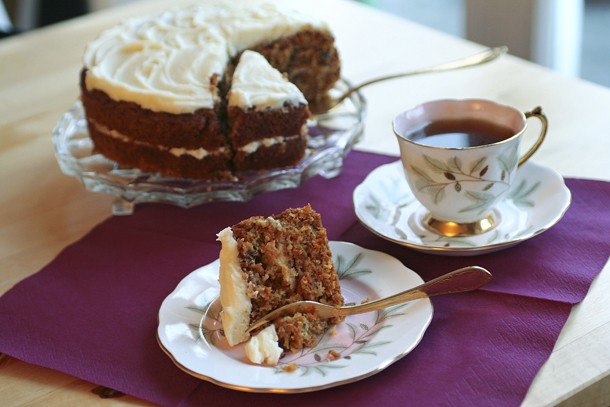
The recipe for this cake is from Pret A Manger’s cookbook Food on the Move. I always liked their carrot cake and this recipe gives you a very similar result. Pineapple pieces are added to the batter, giving the cake some juicy bursts of fruit.

The icing is very sweet but with a cake being this dense, it works. However, if you are having this cake for brunch, you might want to go easy on it. If you are having another piece as a treat later on in the day, bring it on!

You’ll need:

  • a 21cm round baking tin
  • baking paper

For the Icing:

  • 400g icing sugar
  • 100g cream cheese
  • 50g unsalted butter

For the Cake:

  • 2 eggs
  • 200g soft brown sugar
  • 150ml sunflower oil
  • 200g grated carrot
  • 50g pecan pieces, roughly chopped
  • 75g diced pineapple (fresh or tinned), roughly chopped
  • 50g desiccated coconut
  • 200g flour
  • 1tsp ground cinnamon
  • 1tsp bicarb of soda
  • 1tsp salt

Preheat the oven to 150 degrees and line the baking tin with baking paper.

Start with the icing by beating the butter and cream cheese together with an electric whisk until smooth. Add the icing sugar in three batches, whisking in each batch before adding the next. Put aside in the fridge to set.

For the cake, whisk the eggs until doubled in volume then add the sugar and whisk until pale and fluffy. Keep whisking on a high speed, as you slowly pour in the oil in a steady stream. The mix should hold the shape of a trail across the surface.

Gently fold in the carrot, pecan pieces, pineapple and coconut (I use a big metal spoon for this). Then fold in the flour, bicarbonate of soda and salt and transfer the mix into the cake tin. Bake for 1 hour (do the skewer test…) and if the cake goes too dark at the end of the baking time, cover the top with baking paper or foil to protect it from burning.

When the cake is baked, leave it to cool in the tin for 10-15 minutes before turning it out on a wire rack to cool it completely. When cold, slice the cake in half horizontally and spread one half with half the icing and sandwich the halves together again. Then cover the top with the rest of the icing and you’re done!

 

Poppy Seed Pancakes with “Saucy Oranges”


I just can’t get enough of pancakes, it seems.

After about four months of blogging, this is already the fourth time that I am telling you about another pancake recipe. I guess, it’s not that surprising as pancakes make such a satisfying brunch – they are yummy and quick and easy to make! Another reason why I have one more pancake recipe here for you is that I it was time to tidy my spice cupboard and in the back, behind all the little glasses and boxes of all sorts of spices I found a small bag of left over poppy seeds (not sure how they had moved from the baking cupboard to the spice section…). This meant that I had to look for recipes that would use up these few black poppy seeds and of course I opted for a pancake recipe!

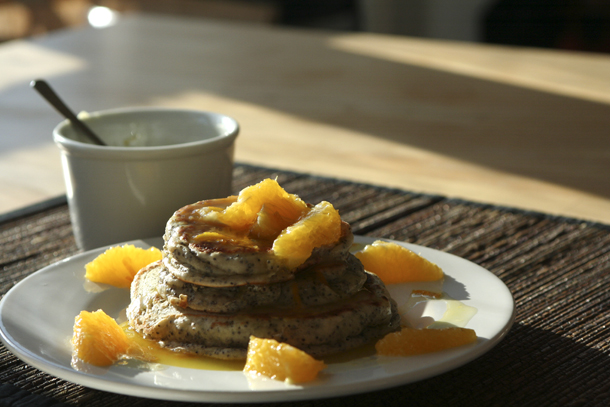
I found it on 101 Cookbooks and have slightly amended it, omitting the sunflower seeds. The author suggested a citrus syrup with it and I liked the idea of this combination but opted for an orange sauce I had made in the past, also because I didn’t have agave or maple syrup in the house.”Orange sauce” makes me think of the colour more than the fruit… so that’s why I shall be calling it “saucy oranges” from now on The “saucy oranges” are also easy to make, as long as you mix the cornflour with a bit of the warm water first, before adding it to the hot sauce on the stove – otherwise the sauce may go lumpy.

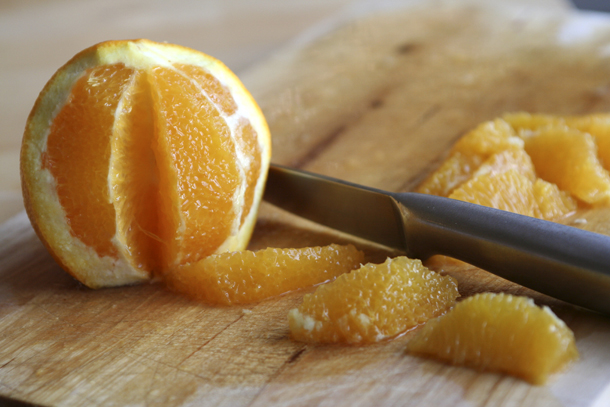
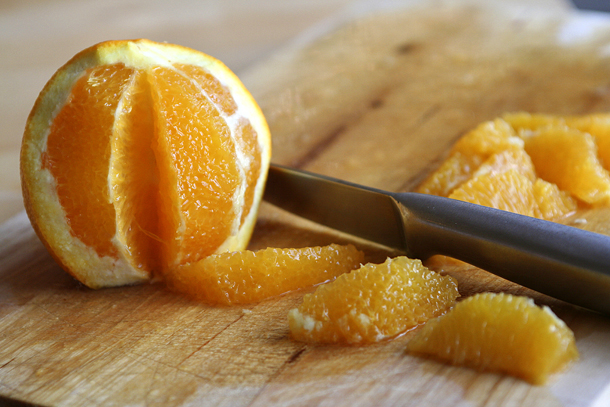
As for filleting the orange, I used to think it requires the knowledge of some chef trick and was worried about creating a big mess trying to get out some clean orange segments. From a cookery class at Leith’s cookery school I then learned that it isn’t very hard, as long as you have a very sharp knife. You have to cut off one end of the orange to create a flat surface, before you can start cutting away at the orange so the orange doesn’t move about. And don’t be shy to be quite generous when cutting away the peel to make sure the orange segments are clean of all pith.


Pancake recipe based on 101 Cookcooks.
For about 4 portions you will need…

Starting with the “saucy oranges”:

  • 7 oranges
  • 25g caster sugar (about 2 tbsp worth)
  • juice of ½ lemon
  • 2tsp cornflour

Take 5 of the oranges and cut off the bottoms so they sit on a flat surface. Using a very sharp knife cut away the peel & pith, following the round shape of the orange with your knife. Then cut out the segments. Try and collect any juice that might collect on the board as you go along. Leave orange segments and juice to the side.

Cut the rind of the other 2 oranges with an orange peeler that gives you small matchstick strips, then squeeze the juice from these oranges into a small pan and add the rind. Add the sugar and lemon juice and simmer gently for 5 minutes until the sugar has dissolved and the rind is tender.

Blend the cornflour with 1 tbsp of water in a small cup, then mix in a little hot juice. Add to the pan and cook, stirring for 1 minute until the sauce has thickened. Take off the heat and add more orange juice if you like.

Add the juice and segments to the sauce, cover and chill.

For the poppy seed pancakes (recipe based on http://www.101cookbooks.com/archives/poppy-seed-pancakes-recipe.html):

  • 2 cups flour
  • 1 tsp baking powder
  • 1/2 tsp baking soda
  • 1/2 tsp fine grain sea salt
  • 1/2 cup poppy seeds
  • 2 1/4 cups organic buttermilk
  • 2 large organic eggs, lightly beaten
  • ½ tsp vanilla extract
  • 2 tbsps butter, melted (plus extra for the pan)

Combine all the dry ingredients – flour, baking powder, bicarb of soda, salt and poppy seeds in one bowl. In another small bowl or jug, combine the buttermilk, eggs and melted butter. Stir the wet ingredients in the dry mix until just combined (I found the batter to be quite thick).

Heat the pan to medium-hot and brush it with a bit of butter. As a test for the right temperature 101 Cooks suggests: “If a drop of water dropped onto the pan starts to dance, you are in the ballpark.”

Bake the pancakes, each of about 1/3 of a cup, and wait until the pancake bottom is deep golden in colour, then flip and cook the other side until golden and cooked through.

Warming and Healthy Quinoa

Happy New Year!

I thought it would be good to start the new year with something healthy.
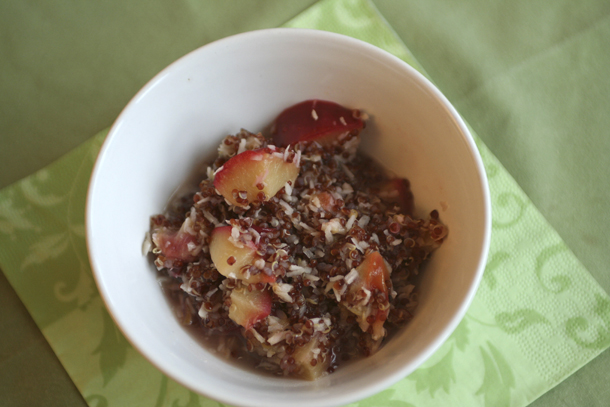
Don’t worry it wont last long, I like my sugary treats too much to become a full time health fanatic. However, some so called super foods have successfully found their way in to my kitchen and gluten free quinoa is one of them (though it is not as photogenic as I’d like it to be…).

I discovered it as a breakfast option when I had the pleasure of visiting an Ayurvedic health spa in Germany. They were quite peculiar about their food in this spa, for example eating desserts before mains, but every morning they served us what they called “warm muesli”. I think it is better described as warm quinoa porridge but either way I very much enjoyed it. It is very filling – quinoa being high in protein helps with that – and as it is made with cinnamon, coconut and vanilla it is really tasty too.

On my last day I asked the kitchen for the recipe and was told that it’s often made up as they go along by adding different fruit, compote or even jam depending on what’s available. But the main principle is cooking quinoa with desiccated coconut and adding flavour with cinnamon, vanilla extract and fruit. In the spa they usually used agave syrup to sweeten the quinoa but when I don’t have that at hand I find that maple syrup works very well too. I recommend using red quinoa in my recipe as I find it has a slightly nuttier flavour but any quinoa would work in the same way.

This bowl of warming vanilla flavoured comfort food makes for a nice brunch on a cold and grey winter morning.

For one very generous portion – or two small ones – you’ll need:

  •  1/4 cup red quinoa
  • 1/4 cup desiccated coconut
  • 2 plums – or any other fresh fruit you fancy (I found apricots worked well too)
  • 1 cinnamon stick
  • 1/4 tsp vanilla essence
  • maple or agave syrup to taste 

Put the quinoa, coconut and cinnamon stick in a saucepan on the stove and cover with 1 cup of boiling water and leave to simmer on low heat for 20 minutes. You may find that you need to add a little more water as the quinoa cooks and absorbs the water. Keep an eye on it as you don’t want the quinoa to burn to the bottom of the pan as the water has dried up!

Cut the plums (or other fruit) into small pieces and add to simmering quinoa for the last 10 minutes along with the vanilla essence.

Please note, that if you are using a soft fruit such as mango or berries and you don’t want them going too soft/ falling apart, you may want to cook them for less than 10 minutes so maybe add them for only the last 5 minutes.

The quinoa will need about 30 minutes in total to be cooked through – you want a risotto like texture, with the quinoa soft and the water (or at least most of it) absorbed.

Add agave or maple syrup to sweeten and enjoy!


Christmas Cranberry & Almond Cakes

Frohe Weihnachten!

I am writing this from Germany where I am spending Christmas with my family. Here, Christmas has already started as today is Christmas Eve and that is the day where we go to church, have a special Christmas dinner and get to open the presents with which the children get to play until late at night.

We then still have Christmas Day and Boxing Day (which we call second Christmas Day in Germany) to celebrate some more with some big roast lunches usually with goose or duck. Because of all these big dinners and lunches, we don’t usually have Christmas brunch in my family but I heard that the Christmas breakfasts in the UK and US are a much bigger thing and lots of food blogs I follow suggested special Christmas muffins or rolls for the occasion. On one of the blogs, Roost, I saw a recipe for some “Upside Down Cranberry Cakes” that I liked the sound of , so I decided to try them out and suggest them for your Christmas breakfasts.

They are not too sweet which is good as there is already a lot of sweet chocolate to get through over the festive days and they are sugar and gluten free. This might please my friends Leanne, Tracey and Emma and anybody else that’s gluten intolerant.

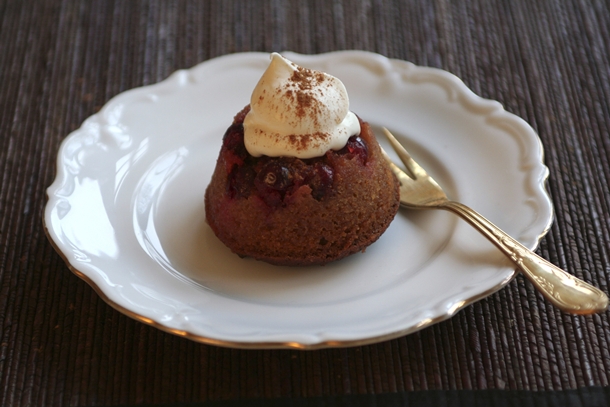
They’re made in a muffin tray and then turned upside down so that the shiny cranberries can be seen. Add a dollop of whipped cream and a dusting of cinnamon and there you are.

Merry Christmas everybody!

Recipe based on Cranberry & Almond Upside Down Cake by Roost.

For 10 – 12 muffin sized cakes you’ll need:

  • a greased muffin tin
  • 2 1/2 cups ground almonds
  • 1/2 tsp salt
  • 1/2 tsp baking soda
  • 1 1/2 tsp ground cinnamon
  • 1 tsp ground all spice
  • 3 eggs
  • 1/2 cup sunflower oil
  • 1/2 cup honey

For the cranberry layer:

  • 2 cups fresh cranberries
  • freshly grated orange zest of 1 Orange
  • freshley grated lemon zest of 1 lemon
  • 1/4 cup honey

To serve:

  • whipped cream

Preheat oven to gas mark 4.

Mix flour, salt, baking soda, cinnamon and all spice in a bowl.
In another bowl whisk the eggs, oil and honey.
Then combine the wet and dry ingredients with a fork until mixed through and set aside.

Now mix the cranberries with the citrus zests  and honey and spoon them into the  muffin tray cups. The should result in a single layer with a few extra cranberries on top in each of your 10 – if not 12 – muffin cups.

Top with the cake batter, which doesn’t have to go to the top of the muffin cups but should have an even surface.

Place the tray  in the oven for 20-25 minutes or until the tops are golden brown and cooked (tooth pick test!).

If your cakes get too brown but need to cook  a few more minutes, place some foil over the tray and continue cooking.

When the cakes are ready, let them cool down in the tray for a few minutes and then take them out, turning them upside down to finish them cooling off on a wire rack. If the middle of the cakes have risen, you may need to cut the risen dome off to make a flat surface that the cake can sit on (uspide down).

Serve with some whipped cream.

Mulled Wine Cake

Last weekend I met up with an old school friend from Germany who was visiting London for a few days. It was great to see her again and delve into some school time memories …

Talking about our old high school reminded me of all sorts of things, one of them being the cakes people used to bake each other for birthdays. “Rotwein Kuchen”, red wine cake, was always one of the most popular ones! We probably thought it was cool to have red wine cake at school although the alcohol content would probably be pretty much zero after the baking. The cake really tastes like a light, moist and slightly chocolaty loaf cake and as most German cakes, is not too sweet.

With it being Christmas time right now, I thought, why not give the cake a little make over by using mulled wine instead and it worked!

You may find yourself with a little left over mulled wine the day after your Christmas drinks. Though as mulled wine gets drunk up rather easily, it might be a better idea to set a glass aside for some baking the day after. 

For the cake you’ll need:

  • 250g butter or margerine
  • 250g caster sugar
  • 8g vanilla infused sugar (for Germans, this is 1Pk Vanille Zucker)
  • 4 eggs
  • 1 tsp cinnamon
  • 1 tsp cocoa
  • 125ml cold mulled wine (or plain red wine)
  • 250g flour
  • 15g baking powder (again, for Germans, this is 1Pk)
  • 100g chocolate sprinkles or small (!) chocolate shavings
  • a little icing sugar to decorate

For the bundt cake tin:

  • butter for the cake tin
  • 2 Tbsp breadcrumbs

Preheat the oven to 190 degrees.

Butter the cake tin generously and then sprinkle the breadcrumbs evenly in the tin.

Whisk the butter with the sugars until creamy and fluffy. Now add the eggs, one at a time, whisking them in.
Add the cinnamon, cocoa and wine and mix again.

Combine the flour and baking powder and mix them in as well.
The last ingredient to go in the batter is the chocolate sprinkles/shavings, which should be folded in.

Pour the mix in the bundt tin and bake the cake in the oven for 50 minutes.

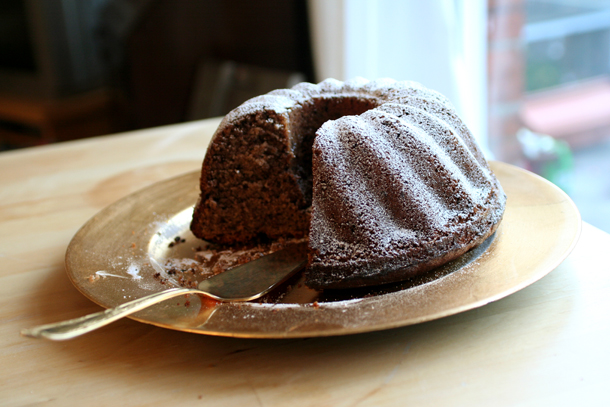
To get the cake out of the form in one piece, a generous buttering and bread crumbs are only the start, as my grandma taught me. Now that the cake is baked you need to let it cool down a little while, say 10 -15 minutes. Then I cut around the ring in the middle of the tin and also make sure that the very top of the cake is loosened a little with the knife, before I turn the tin over on a plate and cover it with a cold wet towel. I let this sit for about 10 minutes and only then lift the tin off the cake. Should it still be sticky you can leave it under the towel a bit longer (you might have to re-wet it). Hopefully you’re cake will come out in one piece and can then be dusted with some icing sugar.